Featured

About the Blog

Welcome gentle readers and automated spambots.

Here you'll find my assorted rants, ravings and recipes on a variety of topics, including Beer, Wine, and Homebrewing, Charcuterie and Meat, Foraging and Mushrooming, Cooking, Music, Law and whatever else I find is, arguably, fit to print.

Monday, April 18, 2011

Brewday: ASBO Bitter

0 comments
I always find it fascinating how law and beer are historically related.

We all know about the effect of the Reinheitsgebot on German lagers. But let's take British Bitters. By American standards, these are some light, wimpy beers. An Ordinary bitter clocks in around 3.7% ABV, Standard bitters around 4.2% and the mighty ESB or Special Bitters around 5%. This can lead to warnings from well-intentioned publicans of "Careful with that one, it's strong!" Despite the fact that most of our familiar NW "session" beers are at least as strong or stronger. As so often happens in history, the reason for this has to do with Victorian England.

In 1880 the Free Mash Tun Act shifted beer taxes from a tax on individual ingredients (malt and hops), to a beer tax based solely on the original gravity of the beer. Beers above 1.057 original gravity were taxed more highly than those with lower gravities. One interesting side effect of this is that the tax and regulations didn't care where that extract came from, so the use of sugars (treacle and invert sugar, for example) and cereals, like corn, increased dramatically. Hence the presence of Lyle's Golden Syrup in many homebrew recipes.

But the most important impact of this law is that, as so often happens, vice taxes tend to rise. The original 1880 tax rate was not that heavy, and beers averaged around 1.055. But by the 1920's, to help pay for the Great War, taxes were very high indeed. At that time Bass is reported to have been spending about 53% of its total production costs in taxes! The trend only continued. On top of the increased tax rate, the 1.057 baseline from 1880 was dropped to 1.037 by 1950. So the incentive was to brew weaker beers, that turned around quickly. IPAs and Old Ales went nearly extinct. Fortunately, since then tax burdens have been relaxed a little and the CAMRA/Craft Brew movement has helped increase demand for more expensive, stronger beers. For more on the remarkable history of British Pale Ales check out Foster's Pale Ale, 1999.

So Americans think of British Ales as low-alcohol, warm, flat, and fruity. But is this a bad thing? For a house beer, absolutely not!

RECIPE: ASBO BITTER

A decade ago in order to combat a wave of perceived lawlessness the UK introduced the ASBO or Anti-Social Behaviour Order, a civil order covering a variety of misdemeanors designed to combat, wait for it, anti-social behavior. Basically, it grants license to magistrates to spank yobbos for minor crimes and has become generally associated with juvenile delinquency.

I'd set out to make a little session Ordinary Bitter. Something pleasant and British, and about 1.037 O.G. so that I'd have a nice 3.7%ish house beer to quaff by the imperial pint and wake up hangover free the next morning. Well, as often happens, efficiency increases on small beers and I ended up with a mighty 1.041 O.G., moving it into Standard Bitter territory. Oooooooh! So in reflection of the warnings about the dangers of "strong" British beer, I decided that this was clearly liquid delinquency in a can. (Though here we just call that Four Loko)

ASBO BITTER

10.5 gallons, All Grain
O.G. Est 1.038, O.G. Act 1.041
Est ABV: 3.7%, Est Act ABV 4.1%.
10 SRM, 30 IBU
Calculated at 75% efficiency, got about 80%. :/
  • 12.5 lbs Gambrinus ESB malt
  • 12 oz Crystal 120
  • 4 oz Organic Crystal 40
  • 8 oz Special Roast
  • 4 oz Flaked Wheat
Mashed in at 153, mashed out 168.

Mash Water Treatment: 4 gm Gypsum, 1 gm CaCl2. Boil Water Treatment: 9 gm Gypsum, 2 gm CaCl2. Should get the Ca up around 100, SO4 up around 130, and Cl around 30. Mash pH was 5.2.

90 min boil.
  • 2.25 oz Willamette, leaf, 5.1% AA, at First Wort
  • 0.75 oz Willamette @ 30 min.
  • Whirlfloc tab @ 15.
  • 1 oz Willamette @ flame out.
Used Willamette because I have a lot of it around. It's the US version of Fuggles, which is a bit harsher and spicier than the standard Kent Goldings, but when I ordered in my massive hop stockpile part of the deal was no more buying hops if I can sub something close. We'll see if it's an ok substitute. Used 4oz because I vacuum sealed them in 4oz blocks.

Cooled to 66 pretty quickly. Very clear wort.

Yeast choice is important for British Ales. For smaller bitters you want a yeast that will produce some fruity esters and has an attenuation on the lower end, around 70%. Otherwise it will be dry and over-bitter. So I pitched a quart of Danstar Windsor Ale yeast, saved off a previous brew. Fermenting in my 15 gallon conical, temp reading was 70 this morning. Luverly. I've had some good luck with this strain, but it doesn't floc well, and forms a top crop. Some careful racking and/or isinglass is in order.

Once it's done I'll probably cask condition it in kegs. British beers like cellar temperatures and there is an unheated room in my basement that's holding about 55. I'll just keep the kegs in there and hook up a cobra tap to it, goose it with co2 every now and again to push it.

Then let the reign of 4% fueled ASBO lawlessness begin!
Read more

Wednesday, March 02, 2011

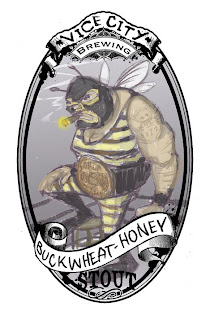
Brewday: Bolt Thrower & the Buckwheat Honey Stout

0 comments
Right, final beer post for today. Then we should be more or less current.

Every year since (let's see... 2006!) I've brewed a version of my Buckwheat Honey Stout for St. Patrick's day. This year's was delayed a bit due to inclement weather and the fact that I brewed two pale ales and two IPAs this last month. But with just seventeen days to go, I got to brewing.

One thing I've noticed recently is that I seem to listen to metal when I'm working on a stout. Or maybe listening to metal makes me want to brew stouts? Chicken and egg. But it all makes sense. Stouts are Metal. \m/ You can see this in my last stout, Iron Swan Stout, named after a song by The Sword. Well this time around I was working on my buckwheat honey stout and listening to Bolt Thrower's Those Once Loyal.


Unsurprisingly, this got me in the mood for a big, bad American stout. One of the problems of the Buckwheat Honey Stout has always been that it's...on the fence. I've usually made it like a bigger, Americanized Dry Irish Stout. But Guinness it is not. The buckwheat honey gives it a little sumpin sumpin, describable only as 'buckwheat honey-y'. Either it needs more buckwheat honey, so that becomes the primary flavor, or more complexity in general. So this time around I decided to throw it firmly into the hoppy, complex American Stout camp.

2011 Buckwheat Honey Stout
All grain, 5.25 gallons
O.G. est 1.066, act 1.068
F.G. est 1.016
Est ABV about 6.75%-7.0%
IBU: 58
SRM: 45+
  • 8 lbs Gambrinus ESB Malt
  • 1 lb Flaked Barley
  • 1 lb MFB Special Aromatic
  • 8 oz Black Patent
  • 8 oz Roasted Barley
  • 8 oz Chocolate Malt
  • 8 oz Crystal 80
  • 4 oz Crystal 135 (The Hugh Baird dark crystal. Briess Extra Special Roast would be perfect here.)
  • 2 oz Rauch malt
  • 1 lb Buckwheat Honey
Mashed in shooting for 152, got 149, adjusted up with boiling water to 153. Fine. Mash pH buffered with 12 gm chalk and 5 gm baking soda. Less soda next time, pH was 5.5, so I lowered it to 5.3 with lactic acid. After 30 minutes to full conversion mashed out at 168. Sparged 7 gallons for a 60 minute boil.
  • 1 oz Apollo (leaf) @ 19% AA @ 60 min
  • 1 oz Centennial (leaf) @ 11% AA @ 5 minutes.
  • Buckwheat honey added at the last minute or two.
Cooled down to 68 and pitched a half-growler full of the yeast from the IPAs, which I'd washed earlier. Kraeusen within about 30 minutes again. Brewday, start-to-cleanup, about 4 hours. Must be a new record.

So this thing will go for about week, then I'll cold crash it and rack it into a keg for St Patty's. Not sure whether I'll put it on nitro or not, and I may blend some of it with a secret project I've got going on.

In conclusion, CENOTAPH!!!!

Read more

Brewday: IPA Experiments

0 comments
Moving on in my quest to brew a decent hoppy beer I geared up to brew some IPAs.

Similar to the SMaSH Beers, I developed a base recipe for the wort, then divided the boil to test out two different hop profiles. Something reasonably light, with restrained crystal malt, and about 6% ABV. One would be a single hop IPA using Centennial, in the spirit of Bell's Two Hearted Ale. The other would be a more complex session IPA, in the spirit of Bridgeport IPA. Bridgeport uses an interesting mix of American, British and German hops. Complexity seemed worth a try. One of the problems here is that they use five hops, only one of which I had. So I made some substitutions.

Speaking of substitutions. I had to throw my ideal malt bill out the window. It's winter here in the NW and I still have to brew outside. A sunny, crisp cold morning arrived and snow was forecast for the upcoming day I'd intended to brew on. Well, better make beer while the sun shines! Unfortunately I didn't have all the ingredients I wanted and the stores weren't open for a couple more hours, so I made a few substitutions.

Get It Right IPA - Ideal Grain Bill
  • 11 lbs ESB Malt
  • 2 lbs MFB Special Aromatic
  • 8 oz CaraHell
  • 4 oz Crystal 40
Get It Right IPA - Actual Grain Bill
  • 12 lbs ESB Malt
  • 1 lb Vienna Malt
  • 8 oz Crystal 10
  • 4 oz CaraWheat (55L)
Same deal as last time. Mashed in at 152, mashed out at 168. 6 gm gypsum, 3 gm CaCl2, 5 gm Epsom salts. Pulled 9 gallons, divided and topped up to two boils of 5 gallons to get 3.25 into the fermenters. 60 minute boils for an O.G. of 1.060. Repitched right onto the happy yeast from the pales. Kraeusen within 30 minutes!

Get It Right IPA - Centennial (Two Parted Ale)
  • 1/4 oz Centennial (leaf) @ 11% AA @ 60 minutes
  • 3/8 oz Centennial @ 45
  • 3/8 oz Centennial @ 30
  • 3/8 oz Centennial @ 15
  • 3/8 oz Centennial @ 1
  • 2/3 oz Centennial @ Dry Hop 5 days.
IBU: 57

Get It Right IPA - Four Hop (Sub-Humulone)
  • 1/2 oz Apollo (leaf) @ 19% AA @ 60 min
  • 1/4 oz Centennial @ 11% @ 15
  • 1/4 oz Willamette @ 5.1 @ 15
  • 1/4 oz Ger. Hallertau Hersbrueker @ 3.5% @ 15
  • 3/8 oz Centennial @ 1
  • 3/8 oz Willamette @ 1
  • 3/8 oz Hersbrueker @ 1
  • 2/3 oz Centennial @ Dryhop 5 days.
IBU: also about 57

These just went into the kegs yesterday, so I haven't really got an opinion on them yet. I'm hoping for good things, but always pessimistic about my IPAs.

One problem occurred while racking off the dry-hops. I'd wrapped cheesecloth around the tip of the autosiphon to filter out the loose hops. But as they clogged up around the cloth, the pressure difference caused the loose gasket of my aging autosiphon to draw air bubbles into the line. I'm going to be really upset if these beers are badly oxidized. :*(
Read more

Brewday: SMaSH Pale Ales - Apollo and Cascade

0 comments
SMaSH - Single Malt and Single Hop.

The best way to see exactly what a hop or a base malt tastes like, without any distractions.

Recently I've been looking for a new base malt. In the past I used Great Western 2-Row Pale, which I liked because it's from Washington and it's cheap. But I was unsatisfied with the grain uniformity, chaff levels, and I was getting really inconsistent grinds off of it. Moving the rollers closer together did a better job, but ended up pulverizing the other malts in the grain bill. As a result I was getting a fairly low yield and, dissatisfied, I started looking around.

I was gearing up to brew Free Ballard! and went shopping for a sack of Pilsner malt. My preference is to use Weyermann. It is simply fantastic malt. But you'll also pay through the nose for it. Unfortunately most shops around here carry Best, which I have not been as happy with. Well, I came across a sack of Gambrinus Organic Pils that had mistakenly been delivered to my LHS. Got it at a steal and gave it a try.

Excellent. Kernels are nice and plump, and quite uniform. Much closer to Continental malt. Which is interesting, because Gambrinus is in Canada. Low protein levels, so no rest was needed. Nice. Brewed a little lager up using just it, some Horizon for bittering, and Sterling for Flavor and Aroma. Free Ballard! came out great, there's a lovely maltiness to it, with just a hint of sweetness. Big fan. And it's way, WAY cheaper than Weyermann. Sweet.

So I decided to give their ESB malt a try. Picked up a sack down at Larry's for about $40, and brewed up some pale ales.

Now, one thing that I freely admit in my brewing is that I suck at brewing hoppy beers. I don't know what it is, but my pale ales and IPAs have always seemed lackluster. Maybe I'm just really picky about it, and maybe I'd been guilty of using hops that were free but less than fresh. So I decided to try and do it right this time. A decent pale ale and a decent IPA, or bust!

The first step was getting some decent hops in. Now, it's great that I live in WA and that most of the country's hops are grown about three hours away. But I also feel that the really choice hops tend to go to breweries, and we homebrewers seem to get the next grade or two down. I've also seen hops from two years or more ago floating around. Not much you can do about that other than get to know the difference between fresh and not-so-fresh hops yourself and get picky. Also, the shops charge a huge markup. I was sick and tired of paying $6-$8 for two ounces of hops.

Fortunately, I got a vacuum sealer for Christmas. (I know, just what every kid wants!) So I went to HopsDirect and ordered in six pounds of hops for about $70. Got a representative selection, covering all my bases:
  • Cascade - the classic NW hop. Piney and citrusy. High cohumulone levels.
  • Centennial - more alpha acid (AA) than Cascade, similar flavor, lower cohumulone.
  • Willamette - I really like Willamettes. They've got a pleasant British hop character, reasonable AA level, and as a very heavily planted hop, they're cheap!
  • Sterling - Back before I brewed lagers I never really had much use for Sterling. But now I love this hop. It's like Super Saaz. Same noble, perfumy, floral thing going on, but with twice the AA levels so you don't need loads of it.
  • German Hallertau Hersbrueker - Wanted to get another noble variety in to do a little side by side comparison later on.
  • Apollo - Rare new variety released just a couple years ago. One of the latest "Super Alpha" varieties. These clocked in at 19% AA! I was a bit skeptical. The last time I used a Super Alpha variety it was Summit, and I'm never using those again. Whew, the onion and garlic of hops. But looking further Apollo has low cohumulone levels, around 26%, and basically three-way split in its hop oils. This means it should have a clean bitterness, with flavor and aroma qualities across the Noble/American spectrum. Very interesting. Clearly worth a try.
Whipped out my vacuum sealer, repackaged into smaller bags. Hops Direct is usually somewhat generous on their measurement, and now I've got a freezer full of hops for the year.

I was really curious about the Apollos. Would they be useful as a flavor and aroma hop, or are they only good for cheap, effective bittering? SMaSH time!

The idea would be to pull enough wort for a 6.5 gallon batch, but split it into two different batches of 3.25 gallons. One would be the fancy new Apollos, the other would be Cascade, as a classic 'control' group. Normal American Pale Ale, somewhere around 5% ABV and 40 IBUs, with a flavor addition at 10 minutes and flameout, and a dryhopping. Then I'd keg them in my two 3-gallon kegs, carbonate and compare.

SMaSH Pale Ale - Gambrinus ESB and Cascade/Apollo

Calculated at 6.5 gallons, All Grain
About 5 SRM, O.G. 1.052
  • 12 lbs Gambrinus ESB malt
Mashed in at 154 with 6 gm gypsum, 3 gm CaCl2, and 5 gm Epsom salts. Mashed out at 168 and collected 8.5 gallons of wort.

Divided the wort into two 4.25 gallon batches and added 1/2 gallon more water to each for a starting boil volume of 4.75 gallons each. Kettle geometry means an hour boil will be very vigorous for a 3.25 gallon batch, estimated (quite accurately) a 1.5 gallon boil-off.

Each got a 60 minute boil. Hop Profiles:

Apollo
  • 1/4 oz Apollo (leaf) @ 19% AA @ 60 minutes
  • 3/8 oz Apollo @ 10
  • 3/8 oz Apollo @ 0
  • 3/8 oz Apollo @ Dryhop (3 days)
Cascade
  • 1 oz Cascade (leaf) @ 7.3% AA @ 60
  • 3/8 oz Cascade @ 10
  • 3/8 oz Cascade @ 0
  • 3/8 oz Cascade @ Dryhop (3 days)
Fermented both with Safale 05 American Ale yeast, at around 66-68. Kegged and carbonated to 2.5 volumes.

Results:

Both beers are young but I can draw a few conclusions.

Appearance. Both (surprise, surprise) have the same pale straw color verging on gold. Both have a slight haze from the dryhopping. Holds a decent enough head, but not fantastic. Maybe a little CaraHell next time I brew it as a non-SMaSH beer.

Aroma. Noticeable hop aroma. The Cascade is distinctly piney, while the Apollo is much more complex. Pleasantly hoppy, slight floral.

Taste. The Cascade, again, has a distinct piney edge to it. A little bit grassy too. The Apollo seems much cleaner, more just generally 'hoppy' and less assertively bitter. They're both quite drinkable, but a little light crystal malt would help balance the hops better. But that would miss the point of a SMaSH beer. Slight biscuityness from the ESB malt.

Conclusion. We'll have to give them another week or two cold to rest, but to my tastes the Apollos are a real winner. I also think though, that I am really turning against high cohumulone beers, so if that's your thing you might like the Cascades more. I'm going to bring both to my homebrew club meeting tonight and see what the jury thinks. I do like that I could brew twice as much of the Apollo version using the same amount of hops as the Cascade version. Go 19% AA!
Read more

Monday, February 28, 2011

And we're back. Again.

5 comments
Well a few weeks ago my laptop bricked. And for whatever reason I just can't seem to get much writing done on my desktop. Too many distractions. Screen hurts my eyes. Etc. But I've arranged use of another laptop. Even if (thanks to a prior soy sauce related disaster) it doesn't have a comma key. :/ Also the T key doesn' work very well. Ugh.

One question I've been dealing with is whether to post brew updates as soon as I brew them. On the one hand I've been hoping to get more of a complete wrapup of each beer start to finish. On the other I've found that writing as soon as I brew acts as a really useful brew journal. Records of gravities, last minute substitutions, mishaps and so on. So I think I'm going to keep a record as I go unless it's a big project.
Read more

Wednesday, December 29, 2010

Brewday Catch Up

0 comments
I've been brewing up a storm. Many of these have been test-batches of some Belgians I want to try and work on, others are seasonal or session house beers. Some good, some not so good. Always a work in progress. Here is about 3 months worth of brewing.
  • Brother Russell's Dubbel
Repitched the yeast from the Chanterelle Belgian, which is certainly the best of the string of Belgians. O.G. 1070. Pale, Munich, Aromatic, Special B, and Caramunich, with blackened honey and amber candi syrup, and 3 oz each dried cherries and prunes at the end of the boil. Came out ok, but finished a little sweet, probably due to a little too much Special B and a little too cold a ferment. The blackened honey had a nice toasted marshmellow thing, but it would be better in, say, a Toddy Porter.
  • Tom Kha Tripel
Fresh yeast, Saf T-58. O.G. 1080. Pilsner, Special Aromatic, Caravienne and Wheat. Magnum and NZ Hallertau. Inverted Thai palm sugar, galangal, lemongrass and kaffir lime leaves. Decent attenuation, up around 80%. Nice and dry, good carbonation. A bit heavy on the lemongrass, 4" at the last 5 minutes was too much.
  • Cider
Picked up 10 gallons of cider this time. In secondary in the cellar until April or May when I'll bottle it. Given that the last batch is 2 for 2, that is, 1st place in the WA Mead and Cider Cup and Best in Class at the Evergreen State Fair, I have high hopes for the next batch!
  • Pumpkin Spice and Christmas Spice Ales
10 gallon batch. O.G. 1054. Pale, CaraAmber, Crystal 60, Extra Special Malt, Melanoidin, Roast Pumpkin, Pumpkin Seeds, and Invert Sugar. Northern Brewers and Kent Goldings. Windsor Ale Yeast. Spiced half with Pumpkin Pie spice soaked in Liquor 43, half with more gingery Christmas spices in Bourbon. Total nightmare to sparge, chundery and thick in the ferment, pain to clear, finally needing Isinglass. Going to have to use a stovetop partial mash next time to get the pumpkin to sparge better. Otherwise, fairly tasty on nitro.
  • Free Ballard! Secession Lager
10 gallon batch. O.G. 1050. 100% Gambrinus Organic Pilsner malt. Horizon and Sterlings, about 35 IBUs. Saf-23 dry lager yeast, then some Wyeast Bohemian Lager when the 23 was being sluggish. Currently lagering.
  • Yggdrasil Mk 1
The World Tree. Designed to be this year's Winter Ale. A jet black, 9% Belgian Strong Dark, oaked, with Aquavit Spices. O.G. 1090. Pale, Munich, Caramunich, Aromatic, Carafa II, Chocolate, and Special B. Magnum and Pacific Hallertauer. Homemade Amber and Dark Candi Syrup. Aquavit Spices in the last 5 min. Repitched T-58 Belgian yeast. Toasted oak chips for a week. Unfortunately I'm beginning to think the homemade candi syrup isn't wildly fermentable, and also that the T-58 is very temperature sensitive. FG was 1030 so I added the dregs of two bottles of Orval and left it to Brett itself for a while, maybe knock that gravity down a few points. Tried again, sort of.
  • Yggdrasil Mk II
Brewed it again, this time knocking it down to 1084 with the intention being that increased attenuation and lower FG would keep the alcohol level about the same. Dropped the amber and lessened the dark candi syrup and the Special B to make it more fermentable. Swapped the pale for pilsner malt for more maltiness. At the last minute I decided to do a double batch, splitting half off into a different beer. Thought the color would come out ok but it lightened up, the Dark Candi wasn't as effective a darkener as BeerSmith thought. So it's more of a Dubbel. Decided to wood age it, and so it got a 1oz stick of Palo Santo wood for three days. Spicy and intense! Currently in secondary. Can't wait to try it.
  • Ratatoskr
The horned squirrel that lives in the World Tree. The second half of Yggdrasil II: an English Nut Brown, appropriately enough. Designed as a little house beer. O.G. 1.050. Fermented with Windsor ale yeast. Crushed a half pound of Victory malt, steeped on the stove at 150 for 20 minutes, then added the strained liquid to the boil to add the needed biscuit malt that was absent in the main grain bill. About 25 IBUs, just some Nugget for bittering and that's it. Going into a keg tonight if I can get a move on it.
  • Iron Swan Stout
Needed a winter beer that was big but not too big, hoppy but not too hoppy, and what better to do than a big American Stout. 10 gallons. O.G. 1062. Pale, Munich, Aromatic, Flaked Barley, Black Patent, Roasted Barley, Chocolate Malt, Extra Special malt. Columbus and Cascade for hops, about 60 IBUS. Windsor Ale yeast. Serious water mods on this one, estimated that the pH, unaltered, would be 4.8 thanks to the lack of buffering minerals in Seattle's water. Took quite a lot of chalk and baking soda to buffer it to 5.3. Beer came out great! Very pleased with the first keg. Unfortunately I added some bourbon soaked oak chips into the second keg and, while drinkable, it's not nearly as good.

Up next: Ninja...
Read more

State of the Blog

1 comments
It's been a while since the last post. Too long in fact. Truth be told I just haven't felt like writing much lately. Like to say I've been busy, but I've not been any more than usual. It's time to get back in the saddle and get some posts up.

One of the interesting things I've observed over the months of writing this has been the slow changes in subject matter. Without our weekly CSA to provide a sort of forced creativity, the cooking posts have trailed off. Mostly because I haven't really felt like I've been cooking anything really interesting. Not to say I haven't been cooking some good things, but I've been doing a lot of last minute, make it up as I go along, what have I got in the fridge, kind of cooking. Also, the charcuterie posts have dwindled as we've been eating more near-vegetarian things in the last few months. We try to eat only quality meat, from farmers that we know and trust. But quality meat is expensive, so we're not eating a lot of it. Still, a little good bacon or some decent home made stock goes a long way.

Certainly the brewing projects have been a major part of this blog, and I have been brewing up a storm in these last few months. Sadly, I've failed to post a lot of them. I'm sure this is disappointing to those of you who might read this for those recipes, but it also hurts me. I didn't realize how I valued the immediate record of the minor changes and screw ups that occurred on the brew day. So I plan to get those back in order.

Anyhow, here's to another year and another 200 posts. Well ok, probably 50 this year. Let's shoot for one a week.
Read more